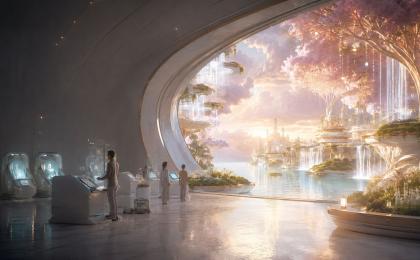
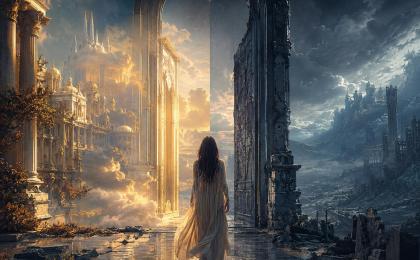
This file documents the in-universe device that explains why personas native to other worlds keep showing up inside Dream Punk/Heaven. It isn't coincidence and it isn't just "guest vocal" as a music convention — there are two distinct, deliberate narrative mechanisms, and knowing which one applies to which persona matters for how their character is written.
The image this comes from
The channel banner shows the artists meeting in Heaven's reception/celebration hall, before they enter the dream capsules — a welcome-and-introduction party. This hall is the intended opening scene of a planned video-series retelling the story behind the songs: it starts here, with dialogue between the characters, and this is how the viewer meets them. Treat "the Reception Hall" as the channel's central crossroads set — the one place characters from otherwise-separate worlds are shown standing in the same room.
Two different things can put a persona in that room, and they are not interchangeable:
Mechanism 1 — Cryo-capsule migrants (they physically live in Heaven's era)
A freezing/cryo-preservation service already existed back in The Present — but it wasn't something you could walk in and sign up for. The technology was secret and government-banned: it had never been able to prove its safety to the (extremely conservative and demanding) global health authorities, so it operated entirely outside the law. Because of that, the company couldn't advertise — it had to find its clients quietly, through at least three distinct channels:
- Wealthy despair recruitment. It scouted for wealthy people, monitored their social media accounts, and sent a personal agent to approach the ones who looked ready: specifically people who'd lost hope in their current life and were open to a one-way gamble.
- Terminal patients. It also marketed directly to patients given up as hopeless by medicine — people expected to die soon regardless — as a last-resort chance at a future cure. This channel genuinely worked, and it's the one that brought in Benny Everon.
- Power holders. Separately, the company did business with people in power who needed a way out if their crimes were ever exposed: a personal escape offer, letting them vanish into a future era where no one would recognize them, safer than fleeing to another country where they'd still be traceable. This is the channel that indirectly produced Mitey Veyra's case — see her entry below.
That's why every migrant below was personally recruited or brought in through one of these channels, never a walk-in customer — and it's also the story's own wink at reality: if a company like this actually existed, you'd never hear about it.
Once recruited, a person could deposit their savings with the freezing company, go into stasis, and the company would invest that money — not as the main business, just a side fund it ran to cover its own long-term operating costs, parked in conservative, safe investments compounding at roughly 1–3% a year across the full century. Part of that fund happened to be invested heavily in Digital Heaven itself — a bet that ended up proving the fund's judgment right. Waking up meant walking out into the Heaven era with a guaranteed stake, savings grown across a timespan the person never consciously lived through. The mechanics of the fund itself aren't important to any of these characters' stories — what matters is the guarantee it gave them. Every migrant below entered stasis around 2021 and emerged exactly 100 years later, in 2121, the year Digital Heaven launched — which is why they all arrive in the Reception Hall together despite having gone under for very different reasons.
These personas ended up physically living in Heaven's era rather than just guesting on a Heaven track — but how each of them got there is different, and each reason shapes their character. Channel 1 above applies to the three voluntary migrants (Moraen, Kairo Vane, Lyliana Whisper) — each was approached individually because they read as hopeless and ready for a gamble. Channel 2 is Benny Everon's route: his family used the terminal-patient program, so the company still had a direct hand in it, just not the despair-targeted recruitment pitch — he wasn't the one making the decision. Channel 3 is where Mitey Veyra's case comes from, but at one remove: it wasn't her deal, it was her jailer's. See her entry below for how that turned into her own imprisonment.
- Moraen. Lost most of his wealth in the stock market — exactly the kind of visible, public collapse the company's scouts watch for. An agent who'd been monitoring his accounts approached him personally once he looked hopeless enough to gamble everything, and he took the offer, banking on long-term cryo-investment to rebuild his fortune. When he woke and walked out of the capsule, he found the Heaven project waiting as the only investment option left standing — the rest of the economy outside paradise had already hollowed out (consistent with Heaven's own founding lore). This is his origin story, not just a backstory footnote — it's the reason he ends up as one of the most prominent voices across both Heaven albums despite not being born into that world.
- Benny Everon — recruited through the company's terminal-patient channel, not the despair pitch. He grew up in an earlier era than the others, the Arcade Era, then contracted a long illness doctors had given up on. His wealthy family enrolled him in the freezing company's last-resort program, hoping a cure would exist by the time he woke, with a small investment balance attached that grew into his ticket into Heaven once he was cured. He migrated for survival, not ambition, and he skipped over The Present entirely — going straight from the Arcade Era into Heaven's "living games" world.
- Kairo Vane (one member of Static Rage, not the whole band). Before the band, he lived through a period of weakness and marginalization that left him hollow — never satisfied, even after Static Rage made him rich. The company's scouts read his wealth and his emptiness the same way they'd read Moraen's: a rich man with no peace, worth approaching. He took the deal chasing a world where every desire could be met and every painful memory could be relived with the ending rewritten: power and victory instead of humiliation. That's the engine behind "Make Them Watch." The other three members of Static Rage — Marlo Redd, Damar Kade, Silas Rue — remain fully in The Present; this is why Heaven I's "Make Them Watch" is credited to Kairo Vane individually rather than to the group as a whole.
- Mitey Veyra — the one migrant who never chose it, and whose case connects to the company only through her jailer. She stood with justice against oppression and was sentenced to 1,000 years in prison for it by an authoritarian ruler. The same freezing company had separately offered that ruler his own personal escape plan — a way to vanish into a future era if his crimes were ever exposed, safer than fleeing to another country where he'd still be traceable. He used that same connection for a second purpose: he had the company freeze his prisoners as a method of punishment. After Mitey Veyra proved her resilience in prison and won the public's heart, he realized executing her would only make her a martyr — so he chose something worse: she would actually live out her sentence, frozen, without ever dying. Fate still intervened: his own authority collapsed after 40 years, but by then she'd been forgotten inside the capsule. She wasn't found until 100 years in, released penniless into the digital Heaven era — where her still-legendary voice earned her a role in the "Krakon Civilization Traders" series (see Mechanism 2 below), and singing there is what actually qualified her for entry into Heaven. She already had a full catalog in The Present (Drift With Me, No Room for Wings) before her imprisonment, which is why that identity survived everything that happened to her.
- Lyliana Whisper. Also approached through the same wealthy-despair channel — a successful digital artist, but one whose accounts read as quietly unhappy with the noisy world she'd built a career in, which was enough to bring an agent to her door. Unlike the others, though, what she said yes to was a pure choice, not a rescue from ruin: she loved meditation and the quiet of space, and she invested her savings into a one-way, no-return capsule migration specifically to leave a loud world she never liked, for a world of mystery on the far side of the universe's calm. No Heaven-credited songs yet — this backstory establishes why she belongs there ahead of any release.
Mechanism 2 — In-universe actors (they never actually left their own world)
Separately, the Heaven era has its own entertainment culture, and it produces dramatized series about the other worlds' histories. Performers from those worlds appear in Heaven as actors playing roles — they are not migrants, and Heaven is not where they live:
- "The Great Migration" — a series dramatizing Earth's Autumn / the City of Endless Rain era. Lymora plays the lead. Because she actually lived through that era herself, the role isn't a stretch — and it visibly affects her even outside the show, which is why her Heaven tracks carry real emotional weight despite Heaven not being her home.
- "Krakon Civilization Traders" — a six-part series dramatizing Krakon Planet's trader civilization, produced and watched during the Heaven era. Mira Velle and other Krakon-world performers play roles in it. Moraen and Mitey Veyra also have acting credits in this same series — "Emma, Stay" (Moraen) and "The Poem That Remembered Me" (Mitey Veyra), both credited under Krakon Planet / Tales from Krakon, are songs from this in-universe show. Neither is a Krakon native: Moraen is a Heaven-era migrant from The Present (see above), and for Mitey Veyra this role is specifically how she rebuilt her singing career and earned her way into Heaven after 100 lost years — not a sign either of them is from Krakon Planet. Lyliana Whisper is also connected to this show's world (see her entry above) though she has no specific acting credit yet.